

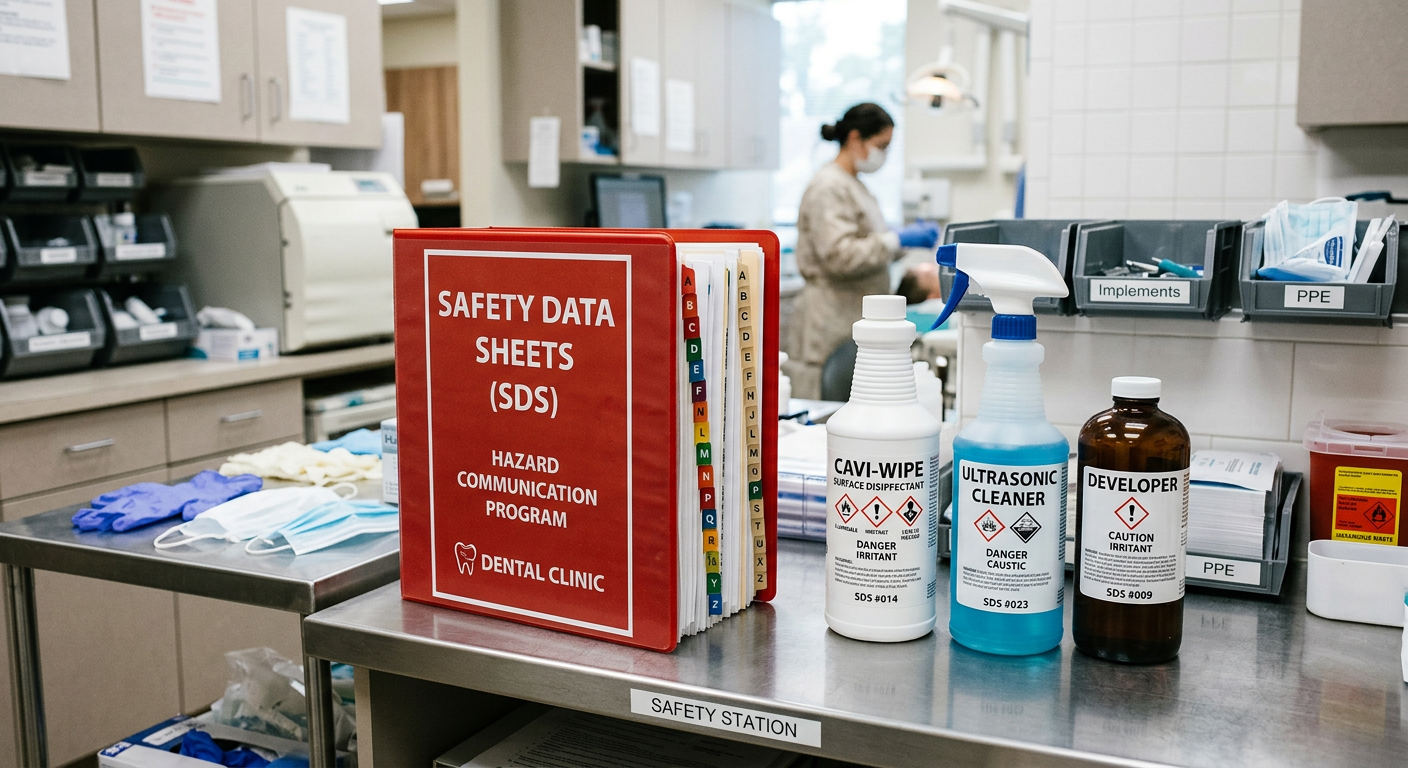
Safety documentation and labeled dental-office chemicals
If an inspector or employee asked for your dental office’s safety documentation tomorrow, could your team produce the correct, current records without searching through old folders?
A binder is useful only when it reflects the work actually performed in the office. Generic plans, outdated review dates, missing training records, and documents copied from another location create the appearance of a program without the evidence of one.
This article provides a practical federal overview. State-plan requirements and local rules can be more protective, so every organization should validate its program by location and with qualified counsel or a safety professional.
1. A site-specific Exposure Control Plan
Dental offices with employees who have occupational exposure to blood or other potentially infectious materials need a written Exposure Control Plan under 29 CFR 1910.1030. The plan must identify exposure risks, describe engineering and work-practice controls, address PPE, housekeeping, hepatitis B vaccination, exposure evaluation and follow-up, communication, and recordkeeping. It must be reviewed at least annually and when new or modified tasks affect exposure.
The annual review should also document consideration and implementation of appropriate safer medical devices and solicit input from nonmanagerial employees responsible for direct patient care who may be exposed to contaminated sharps.
2. Hazard Communication program and current SDS access
If hazardous chemicals are present, the office needs a written Hazard Communication program, a chemical inventory, compliant labeling practices, employee training, and Safety Data Sheets that employees can access during their work shift. “In the manager’s locked office” is not meaningful access.
3. Training records that prove who learned what—and when
Bloodborne pathogens training is required at initial assignment and at least annually for employees with occupational exposure, with additional training when changes affect exposure. Records should include training dates, content or summary, trainer qualifications, and the names and job titles of attendees. Keep the records for the required retention period.
4. Sharps injury log and post-exposure process
Employers covered by the Bloodborne Pathogens Standard must maintain a confidential sharps injury log for percutaneous injuries involving contaminated sharps. At minimum, it identifies the device type and brand when known, the work area, and a brief explanation of how the incident occurred—without identifying the employee.
Important correction
Do not state that every dental office must maintain an OSHA 300 Log. “Offices of Dentists” (NAICS 6212) are generally partially exempt from routine federal OSHA injury-and-illness record-keeping unless specifically required, although all covered employers still have severe-injury reporting duties. The separate Bloodborne Pathogens sharps-log requirement still applies when the standard applies. State-plan rules must also be checked.
5. Supporting programs and records
· PPE selection, use, cleaning, replacement, and disposal procedures
· Housekeeping, disinfection, regulated-waste, laundry, and spill-response procedures
· Hepatitis B vaccination offers, records, and signed declinations when applicable
· Post-exposure evaluation, medical follow-up, documentation, and referral instructions
· Emergency action, evacuation, fire-prevention, and applicable fire-extinguisher documentation
· Equipment-specific safety records and any applicable radiation-safety documentation maintained in the appropriate program location
· Incident, corrective-action, inspection, and annual program-review records
· State- and locality-specific postings, plans, logs, and retention requirements
California and multi-state caution
California operates its own OSHA-approved state plan and may impose requirements that differ from federal OSHA. Cal/OSHA’s Aerosol Transmissible Diseases standard includes conditional rules and exceptions for certain outpatient dental settings; it should not be described as automatically requiring every dental office to maintain a separate ATD plan. Applicability depends on the services performed, screening and referral practices, and the facts of the setting. Multi-state groups should maintain a federal core plus a controlled state addendum for each jurisdiction.
Run this ten-point binder audit
1. Confirm each written plan names the correct legal entity and physical location.
2. Verify the Exposure Control Plan review is current and signed.
3. Reconcile the chemical inventory to current Safety Data Sheets.
4. Audit annual and new-hire training records against the active employee roster.
5. Confirm hepatitis B documentation is complete and confidential.
6. Check the sharps log and post-exposure workflow for privacy and completeness.
7. Verify PPE, housekeeping, sterilization-support, and waste procedures match actual practice.
8. Confirm emergency contacts, referral locations, and reporting instructions are current.
9. Add or update the correct state-specific materials.
10. Document deficiencies, owner, corrective action, due date, and closure evidence.
Audit before the gap becomes an incident
Use the free Dental OSHA Binder Audit to check the core elements of your program and identify where documentation, training, or ownership needs attention.